Who is Goddess Kanaka Durga Matha?
Goddess Kanaka Durga Matha is a radiant golden form of Durga Devi, worshipped as the compassionate yet powerful Mother who protects devotees, removes fear and grants courage, prosperity and victory over hardship. The word “Kanaka” means gold, brilliance and auspicious abundance, so Kanaka Durga is understood as the luminous Durga whose grace shines like divine gold.
Although the name is strongly associated with the famous Kanaka Durga temple of Vijayawada, the spiritual meaning of Kanaka Durga is not limited to one place. She belongs to the wider Durga and Shakti tradition of India, where the Divine Mother appears in many forms, names and kshetras to protect devotees and restore dharma.
Meaning of the Name
Kanaka means golden, radiant, auspicious and precious. Durga means the Mother who protects devotees from difficulty and destroys forces that obstruct dharma. Matha means Mother, showing the intimate devotional relationship between the goddess and her devotees.
- Kanaka: golden radiance, prosperity, purity and spiritual brilliance.
- Durga: the invincible Shakti who removes fear, hardship and adharma.
- Matha: the protecting Mother who guides, nourishes and uplifts devotees.
Origin and Manifestation
Kanaka Durga Matha is understood as a form of Durga Devi, who herself is the supreme Shakti manifested from the combined divine energies of the devas. According to the Devi Mahatmyam tradition, when Mahishasura disturbed cosmic order, the powers of Brahma, Vishnu, Shiva, Indra and other devas came together as one blazing feminine force. That force became Durga, the Mother who defeats adharma.
Kanaka Durga expresses the same Durga Shakti in a golden, auspicious and blessing-giving form. In some regional traditions, the Mother manifests in a particular sacred hill, village, riverbank or city because devotees perform tapas, the land needs protection, or dharma must be restored in that region. This is why Kanaka Durga can be honored both as universal Durga and as the presiding Mother of specific sacred places.
Why This Form Appeared
The deeper reason behind Kanaka Durga’s manifestation is protection and upliftment. Durga appears wherever fear, injustice, arrogance or suffering becomes strong. As Kanaka Durga, the Mother’s golden brilliance also emphasizes prosperity, auspiciousness, household welfare and victory after struggle.
In devotional understanding, she appears for several purposes: to protect dharma, to bless a sacred region, to answer the tapas of devotees, to remove poverty of both wealth and spirit, and to awaken courage in those who feel surrounded by difficulty.
Major Legends and Sacred Background
Kanaka Durga is connected to the larger Durga tradition, especially the victory over Mahishasura and the worship of Mahadevi as the destroyer of adharma. She is also connected with local sthala puranas wherever she is worshipped as the golden Mother of that region.
At Vijayawada, the Indrakeeladri tradition says the goddess manifested on the sacred hill to bless devotees and protect the land near the Krishna River. This is one of the most famous Kanaka Durga traditions, but it should be seen as one important local manifestation within the larger all-India worship of Durga, Bhavani, Ambika, Chandika and Adi Shakti.
Relationship with Durga, Parvathi and Shakti
Kanaka Durga Matha is a form of Durga Devi, and Durga is widely understood as a manifestation of Adi Shakti. In Shaiva traditions, Durga is closely connected with Parvathi Devi, the Shakti of Lord Shiva. In Shakta traditions, Durga is Mahadevi herself, and many goddess forms such as Kali, Lalitha, Bhavani, Annapurna, Chamundi, Kamakshi, Meenakshi and Kanaka Durga are honored as expressions of the same Divine Mother.
This relationship is important for the mythology family tree: Parvathi Devi is the source Shakti, Durga Matha is the heroic protective manifestation, and Kanaka Durga Matha is a golden auspicious form of Durga worshipped through regional traditions and sacred kshetras.
Iconography and Symbolism
Kanaka Durga is visualized as a bright and majestic Mother, often connected with weapons, the lion or tiger, royal ornaments and golden radiance. Her beauty is not merely decorative; it symbolizes victorious Shakti, purity, clarity and prosperity guided by dharma.
- Golden glow: divine abundance, inner light and auspicious grace.
- Weapons: the power to destroy fear, ego, injustice and ignorance.
- Lion or tiger: courage, sovereignty and mastery over restless instincts.
- Motherly face: compassion that protects without abandoning discipline.
- Abhaya blessing: assurance that the devotee need not fear when living with faith.
Important Temples and Sacred Places
Kanaka Durga is especially famous in Vijayawada, but her worship belongs to the wider Durga and Shakti network across India. Devotees who honor Kanaka Durga often also visit or remember many sacred Devi kshetras where the same Mother is worshipped in different names and forms.
- Sri Kanaka Durga Temple, Indrakeeladri, Vijayawada, Andhra Pradesh
- Sri Durga Malleswara Swamy Varla Devasthanam, Vijayawada, Andhra Pradesh
- Jogulamba Devi Temple, Alampur, Telangana
- Ujjaini Mahakali Temple, Secunderabad, Telangana
- Kanaka Durga / Durga shrines in Andhra and Telangana village goddess traditions
- Chamundeshwari Temple, Mysuru, Karnataka
- Mookambika Temple, Kollur, Karnataka
- Kateel Durga Parameshwari Temple, Karnataka
- Kamakshi Amman Temple, Kanchipuram, Tamil Nadu
- Meenakshi Amman Temple, Madurai, Tamil Nadu
- Samayapuram Mariamman Temple, Tamil Nadu
- Attukal Bhagavathy Temple, Thiruvananthapuram, Kerala
- Chottanikkara Bhagavathy Temple, Kerala
- Tulja Bhavani Temple, Tuljapur, Maharashtra
- Saptashrungi Devi Temple, Vani, Maharashtra
- Mahalakshmi and Ambabai Devi Temple, Kolhapur, Maharashtra
- Ambaji Temple, Gujarat
- Harsiddhi Mata Temple, Ujjain, Madhya Pradesh
- Vindhyavasini Devi Temple, Vindhyachal, Uttar Pradesh
- Vaishno Devi Temple, Katra, Jammu and Kashmir
- Jwala Ji Temple, Himachal Pradesh
- Naina Devi Temple, Himachal Pradesh
- Chintpurni Devi Temple, Himachal Pradesh
- Mansa Devi Temple, Haridwar, Uttarakhand
- Kamakhya Temple, Guwahati, Assam
- Kalighat Kali Temple, Kolkata, West Bengal
- Dakshineswar Kali Temple, Kolkata, West Bengal
- Danteshwari Temple, Dantewada, Chhattisgarh
- Durga Puja mandaps and temples across Bengal, Odisha, Tripura, Bangladesh and diaspora communities
Worship, Festivals and Offerings
Kanaka Durga Matha is worshipped through Durga puja traditions, kumkum archana, Devi stotra chanting, lamp offerings, Friday worship and Navaratri celebrations. During Navaratri and Dasara, devotees honor the Mother in many alankarams and pray for strength, prosperity, protection, family welfare and spiritual victory.
- Navaratri: nine nights of worship of Durga and the many forms of Shakti.
- Dasara or Vijayadashami: celebration of dharma’s victory over adharma.
- Kumkum archana: a sacred offering seeking auspiciousness and protection.
- Durga Saptashati parayana: recitation praising the Mother’s victory over demonic forces.
- Friday worship: household prayers for prosperity, peace and the Mother’s grace.
Cultural Significance
Kanaka Durga Matha is deeply loved in Telugu devotion, but her meaning reaches beyond one language or region. She represents the golden power of the Divine Mother that appears in every part of India through different names, local traditions and temple cultures. Her worship links household devotion, village goddess traditions, Shakta philosophy and festival celebration.
Spiritual Message
Kanaka Durga Matha teaches that divine prosperity is not only wealth; it is courage, clarity, protection, discipline and inner brightness. Her golden form reminds devotees to face difficulties with faith, remove darkness from the heart and live with the confidence that the Mother’s grace protects those who walk the path of dharma.
Related Temples
Explore temples →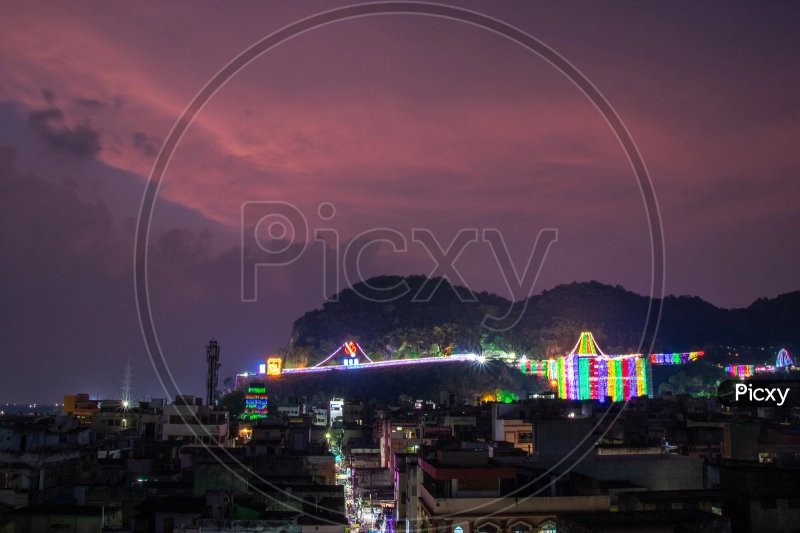

Related Mantras & Slokas
Browse mantras →Continue Exploring
Open related mythology, temple pages, mantras and the interactive connection web.