Heritage · Faith · Tradition
About the Temple
Introduction and Greatness
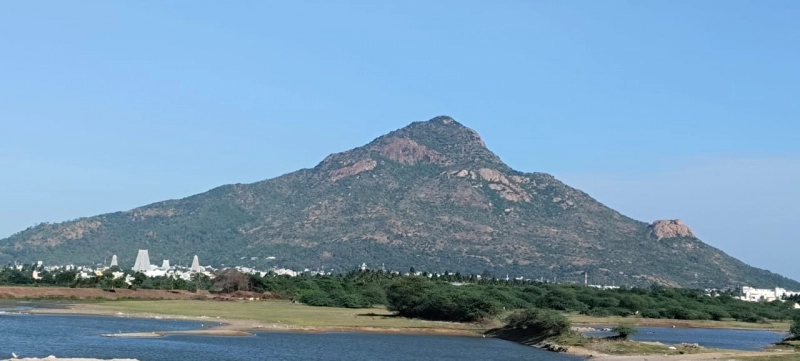
Arulmigu Arunachaleswarar Temple – also well known as Annamalaiyar Temple – is a very ancient Shaiva shrine at the foot of the sacred Arunachala hill in the town of Tiruvannamalai, Tamil Nadu. It is the Agni Sthalam among the Pancha Bhoota Sthalams: of the five elements – earth, water, fire, air and space – Shiva manifests here as the element of fire. He is worshipped as Arunachaleswarar (or Annamalaiyar) in the form of the Agni Lingam, and the Goddess Parvati is enshrined as Unnamalai Amman.
The temple is one of the Paadal Petra Sthalams – the 276 sacred shrines praised by the Tamil Shaiva Nayanar saints in their devotional hymns. It is recognised as one of the largest temple complexes in India.
The name Annamalai has a special meaning in Tamil: anna means "great, unreachable, immeasurable" and malai means "hill" – together, "the hill whose end no one can find". In Sanskrit, Arunachala combines aruna (the red rays of the sun) and achala (unmoving, eternal), pointing to the hill where Shiva dwells as an everlasting flame.
History and Legends
The legend at the heart of this temple is known to all Shaivas. A dispute arose between Brahma and Vishnu over who was supreme. To end their quarrel of ego, Shiva appeared as an endless Jyotirlinga – a pillar of fire pervading all three worlds. Vishnu, as the boar Varaha, dug into the earth to find its base; Brahma, as a swan, flew into the sky to find its top. Vishnu humbly admitted defeat, but Brahma produced a false witness and claimed he had reached the top. Shiva cursed Brahma for his deceit and praised Vishnu's honesty. The pillar of fire later took the form of the Arunachala hill – which is why the hill itself is worshipped as Shiva.
In a second important legend, Parvati playfully covered Shiva's eyes with her hands. As atonement, Shiva sent her to perform penance at Tiruvannamalai. When the demon Mahishasura disturbed her penance, she took the form of Durga and slew him. On the full-moon day of the Tamil month of Karthigai, Shiva took her back as his own – an event remembered every year in the Karthigai Deepam festival.
Historically, the shrine has been worshipped at least since the 7th century. The present stone temple was built mainly under the Chola rulers (9th–13th centuries). The greatest phase of building came under the Vijayanagara Empire – especially in the reign of Krishnadevaraya (1509–1529 CE), when the Rajagopuram and the Thousand-Pillared Hall were built.
Architecture
Arulmigu Arunachaleswarar Temple is a superb example of Dravidian architecture, spread over 25 acres (about 10 hectares).
- Rajagopuram (eastern tower): the landmark of Tiruvannamalai. This massive tower rises 66 metres (about 217 feet) across 11 storeys and is one of the tallest temple towers in Tamil Nadu.
- Other main towers: the southern Thirumanjana Gopuram, the western Pei Gopuram and the northern Ammani Amman Gopuram. The complex has nine gopurams in all.
- Thousand-Pillared Hall (Aayiram Kaal Mandapam): a magnificent hall in the fifth enclosure that reflects the art of the Vijayanagara builders.
- Deepa Darshana Mandapam: a sixteen-pillared hall of lamps in the third enclosure.
- Kalyana Mandapam: a wedding hall built in the Vijayanagara style.
Main Deities and Sub-shrines
The main sanctum faces east and houses the Agni Lingam – a self-manifested (Swayambhu) Lingam, Shiva in his elemental form. The separate shrine of Unnamalai Amman (Goddess Parvati) is in the second enclosure.
- Pathala Lingam: an underground Lingam in a vault beneath the temple floor – the sacred spot where Ramana Maharshi did his earliest and most intense tapas.
- Lingodbhava shrine: a sculpture showing Shiva emerging from the endless pillar of light.
- Subrahmanya shrine: a shrine of Kartikeya (Murugan), south of the Thousand-Pillared Hall.
- Shrines of Nataraja, Durga, Dakshinamurthy and Chandeswara.
- Brahma Theertham: the sacred temple tank within the complex.
- Sthala Vriksham (Magizha tree): childless devotees tie small cradles to this tree and pray to be blessed with children.
Festivals and Celebrations
- Karthigai Deepam: Tiruvannamalai's most famous festival, held on the full-moon day of the Tamil month of Karthigai (November–December). It reaches its climax when the Maha Deepam is lit on the summit of Arunachala. Lakhs of devotees – sometimes more than 30 to 40 lakh – come to Tiruvannamalai for this great festival.
- Girivalam (Giri Pradakshina): on every full-moon night, lakhs of devotees walk the 14 km path around the Arunachala hill. It is believed to destroy the sins of many births and to open the path to liberation.
- Maha Shivaratri: Shiva's great night, celebrated with abhishekam and pujas through the night and the devotees' all-night vigil.
- Chithirai Pournami: on the full moon of Chaitra, a procession of five decorated temple chariots is held.
- Thiruvempavai festival: held in the month of Margazhi, celebrating the hymns composed by the poet-saint Manikkavasagar.
Ramana Maharshi and the Spiritual Legacy of Arunachala
Tiruvannamalai is inseparably linked with Bhagavan Sri Ramana Maharshi (1879–1950). On 1 September 1896, at the age of sixteen, a young man named Venkataraman arrived at Tiruvannamalai railway station and walked straight into the great temple. For the remaining 54 years of his life, he never left Arunachala.
He spent his first weeks in Tiruvannamalai inside the temple – especially in the underground cave of the Pathala Lingam – in deep samadhi. Later he lived in various caves on the hill and finally settled at Sri Ramanasramam. He attained Maha Nirvana on 14 April 1950. Today Sri Ramanasramam draws seekers from all over the world.
How to Reach Tiruvannamalai
- By Air: the nearest major airports are Chennai International Airport (about 185 km) and Kempegowda International Airport, Bengaluru (about 200 km).
- By Train: Tiruvannamalai railway station is about 2 km from the temple, with trains from Chennai, Bengaluru, Vellore and other major cities.
- By Road: TNSTC runs buses from Chennai (about 185 km), Bengaluru (about 195–200 km), Puducherry (about 100 km), Vellore (about 70 km) and Salem.
Visitor Information
- Temple timings: the temple is open every day from about 5:30 AM to 10:00 PM, with six pujas daily.
- Dress code: traditional, modest clothing is required. Shorts, vests and other short clothing are not allowed.
- Best time to visit: October to February has the most pleasant weather. Karthigai Deepam (November–December) and the full-moon Girivalam are the most sacred times to visit.
- Nearby attractions: Sri Ramanasramam, Virupaksha Cave and Skandashramam on the Arunachala hill, the 14 km Girivalam path with its eight Lingam shrines (Ashta Lingams), and Sathanur Dam (about 25 km).
- Pancha Bhoota pilgrimage: devotees often also visit the Sri Kalahasteeswara Swamy Temple, Srikalahasti, the shrine of the air element (Vayu Lingam).