Dharasuram Sri Airavatesvara Temple
Airavatesvara Temple
Kumbakonam, Thanjavur District, Tamil Nadu, India

 Nearby Airport: Tiruchirapalli International Airport (TRZ)
 Nearby Railway Station: Malliyam (MY)
 Nearby Bus Station:
Kumbakonam
Nearby Bus Station:
Kumbakonam
Description:
Dharasuram Sri Airavatesvara Temple — A UNESCO Jewel of Chola Architecture
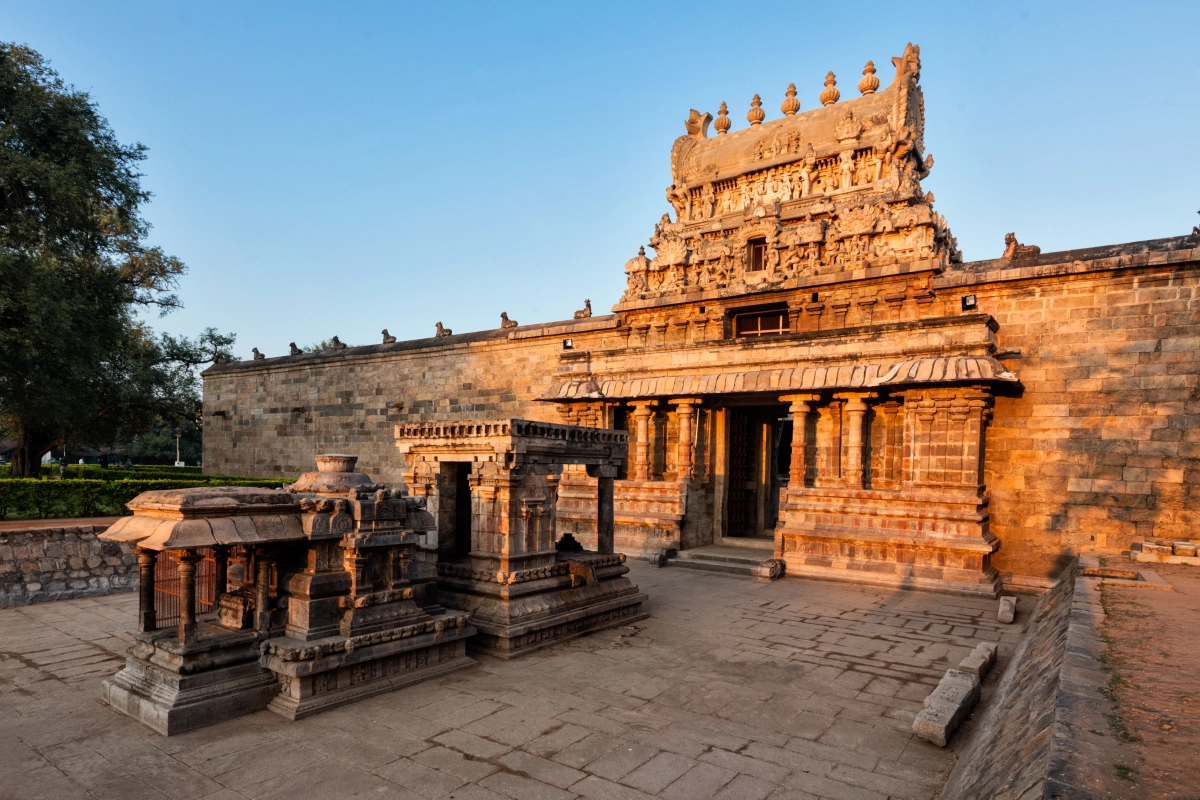
Nestled in the quiet village of Darasuram (Dharasuram), just 4–5 km from the temple town of Kumbakonam in the Thanjavur District of Tamil Nadu, the Sri Airavatesvara Temple is one of the crown jewels of Chola sacred architecture and a UNESCO World Heritage Site. Built by King Rajaraja Chola II around 1166 CE, this temple — the most refined and intricately carved of the three Great Living Chola Temples — is a living monument where ancient legend, architectural brilliance, and daily devotion coexist across nine centuries.
Historical Background
The Airavatesvara Temple was commissioned by Rajaraja Chola II (throne name KoParakesarivarman alias Rajagambhiran), who reigned from 1146 to 1173 CE. Completed around 1166 CE, this temple is the chronologically latest of the three Great Living Chola Temples, following the Brihadeeswara Temple at Thanjavur (completed 1010 CE by Rajaraja Chola I) and the Brihadeeswara Temple at Gangaikondacholapuram (completed ca. 1035 CE by Rajendra Chola I). Contemporary inscriptions named the site Rajarajapuram and formally called the temple Rajarajeshvaramudaiya Nayanar temple. Over the centuries, Rajarajapuram evolved through "Rarasuram" to the modern Darasuram.
The temple has been under the protection of the Archaeological Survey of India (ASI) since 1954 and is managed for daily worship by the Hindu Religious and Charitable Endowments (HR&CE) Department, Government of Tamil Nadu.
UNESCO World Heritage Status
In 1987, UNESCO first inscribed the Brihadeeswara Temple at Thanjavur as a World Heritage Site. In July 2004, the inscription was extended to include the Airavatesvara Temple at Darasuram and the Brihadeeswara Temple at Gangaikondacholapuram, together forming the "Great Living Chola Temples" — a UNESCO World Heritage Site (List #250). The word "Living" reflects the fact that all three temples are active places of worship with daily rituals, not mere archaeological ruins.
Why "Airavatesvara" — The Sacred Legends
The temple's name is inseparably linked to two magnificent legends:
Airavata, the Celestial Elephant of Indra: Airavata is the great white elephant, the divine mount of Indra, king of the heavens. Once, Airavata showed disrespect to the short-tempered sage Durvasa, who had sent the elephant to receive him. In his pride, Airavata trampled or disregarded the sage's sacred floral garland. The enraged Durvasa cursed Airavata, causing his luminous white skin to turn black, stripping the divine elephant of his celestial beauty and status. Distraught and humbled, Airavata descended to earth and prayed fervently to Lord Shiva at this very spot. The compassionate Shiva directed Airavata to bathe in the sacred tank of the temple. When the elephant emerged from the purifying waters, his brilliant white complexion was fully restored. In gratitude, Indra and Airavata continued to worship Shiva here, and the presiding deity came to be known as Airavatesvara — "The Lord worshipped by Airavata." The temple's sacred tank, known as Yamatheertham, has been considered deeply purifying ever since.
Yama, the God of Death: According to another legend, Yama (the god of righteousness and death) was afflicted by a sage's curse that caused a severe, unrelenting burning sensation throughout his body. Yama travelled to this sacred spot, performed penance to Lord Shiva, and bathed in the temple tank. He was completely cured and freed from the curse. In gratitude, Yama is said to have blessed the place: devotees who bathe here will be cleansed of all sins and freed from disease. This is why the sacred tank bears the name Yamatheertham — "Yama's Sacred Water." A shrine in the southwestern courtyard commemorates Yama's devotion and cure.
Architecture — The Chariot Mandapa
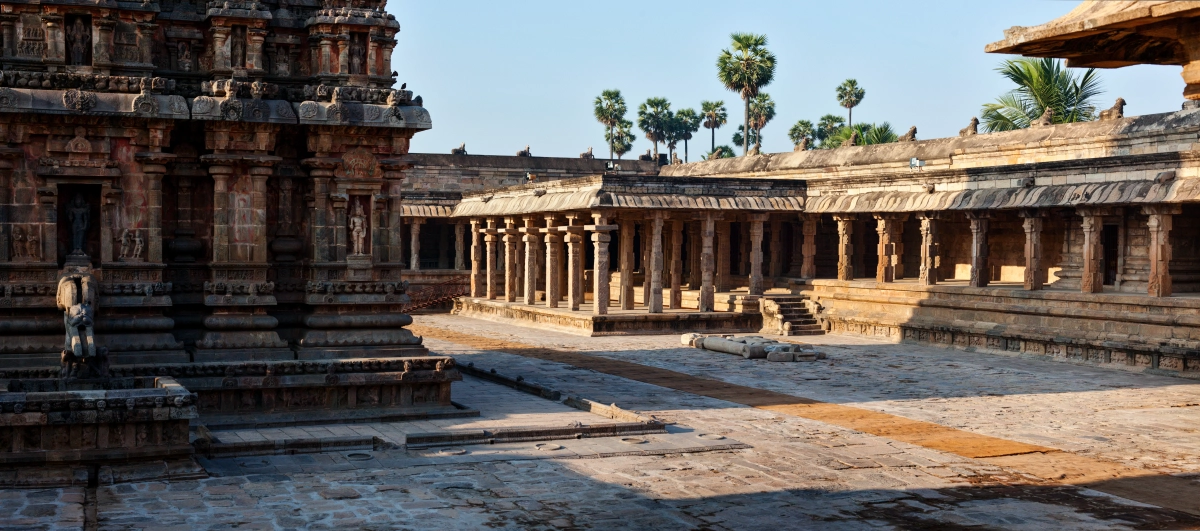
The temple complex spans approximately 107 metres by 70 metres and is built entirely of granite, with deity images in the wall niches crafted in contrasting black basalt. The primary structures include the garbhagriha (inner sanctum), the maha-mandapa (great hall), and the most celebrated feature — the Rajagambhiran-tiru-mandapam, the agra-mandapa (front hall) shaped like a massive stone ceremonial chariot (ratha).
This chariot mandapa is what distinguishes the Airavatesvara Temple among all Chola monuments:
- The entire front hall is built in the form of a grand festival chariot, making this a Karakkoil (a temple fashioned as a chariot)
- Large, intricately carved stone wheels flank the base — according to tradition, these served as sundials, one indicating morning time and the other evening time
- Carved horses and elephants appear as if pulling the chariot forward — a motif of "Nithyavinodham" (eternal divine entertainment)
- The balustrade staircases feature elephant-trunk handrails
- The hall contains 108 intricately carved pillars adorned with Yali figures, dancers, and celestial beings
- This chariot concept at Darasuram is considered an architectural inspiration for the later, more famous Konark Sun Temple chariot design in Odisha
The Vimana
The vimana (tower above the inner sanctum) rises to approximately 24 metres (79 feet) across five tiers, topped with multiple copper kalashas (finials). Forty-six koshta murthies (deity images) are set into the body of the vimana at various levels. Though smaller in scale than the 66-metre vimana of Thanjavur's Brihadeeswara, the Airavatesvara vimana is extraordinary for its sculptural refinement.
The Singing Steps — Musical Marvel
Among the temple's most astonishing features are the seven stone steps near the Balipeetam (sacrificial altar), famously known as the saptha swara padalgal — the steps of the seven musical notes. Each of the seven steps is cut from a single piece of granite to precise geometric specifications, and produces a distinct tone corresponding to one of the seven swaras (notes) of Carnatic music — Sa, Ri, Ga, Ma, Pa, Dha, Ni. The tones emerge from tapping or walking on the steps, arising from the calculated length, width, height, density, and internal acoustic properties of each stone. This mastery of acoustic engineering, rooted in the ancient Shilpa Shastra, is considered largely unparalleled. The steps are now protected within an iron enclosure to prevent damage from visitors.
Sculptures and Artistic Programme
The Airavatesvara Temple is widely acknowledged as the most sculpturally refined of all Chola temples — a "gem of Chola art." Key highlights include:
- 73 miniature narrative panels depicting life events of the 63 Nayanmars (Shaiva bhakti saints) — unique in scope and detail, drawn from Sekkizhar's Periya Puranam
- Sculptures of 108 Thevaram Odhuvars (professional sacred singers)
- Classical dance poses (karanas) carved on the 108 pillars of the agra-mandapa
- Major Shiva forms: Lingodbhava, Ardhanarishvara, Dakshinamurti, Nataraja, Bhikshatana, Tripurantaka, Ashtabhuja Bhairava, Sarabesvara (Shiva as the mythical Sarabha subduing Narasimha)
- Carvings of Brahma, Vishnu, Surya, and the eight Dikpalas (directional guardians)
- Scenes of Ravana lifting Mount Kailasa, the burning of Manmatha (Kama), the divine wedding of Shiva and Parvati, and the birth of Skanda
- The river goddesses Ganga, Yamuna, Godavari, and Narmada personified in feminine form
- Nayaka-period paintings (post-Chola, 16th century) visible on some inner walls, overlaying the Chola-era sculptural tradition
Deities
- Primary deity: Lord Shiva as Airavatesvara, enshrined as a Shiva Lingam, facing east
- Consort: Goddess Periya Nayaki (also known as Deiva Nayaki), enshrined in a separate temple to the north of the main complex
- Sacred tree (Sthala Vriksham): Vilvam (Bael/Bilva)
- Sub-shrines: Sarabheshvara, Yama, Ganesha, Valli-Devasena-Murugan, Kannappar, Nandikeshvara, Nagaraja, Annapurna
Visitor Information
- Location: Darasuram village, Kumbakonam Taluk, Thanjavur District, Tamil Nadu
- Distance: ~4–5 km from Kumbakonam town; ~35–40 km from Thanjavur city; ~310 km from Chennai
- Timings: Morning 6:00 AM – 12:30 PM; Evening 4:00 PM – 8:30 PM (daily)
- Entry: Free for Indian visitors; INR 50 for foreign tourists
- Nearest railway: Kumbakonam Railway Station (~4–5 km)
- Nearest airport: Tiruchirappalli International Airport (TRZ), ~90 km
- By road: Autos and taxis available from Kumbakonam bus stand; well-connected by Tamil Nadu government buses from Thanjavur, Trichy, and Chennai
- Best time to visit: October to March; major festivals include Maha Shivaratri and Chithirai festival (April–May)