
 Nearby Airport:
 Nearby Railway Station: Rishikesh
 Nearby Bus Station:
Description:
Dhari Devi Temple — The Fierce Guardian Goddess of Uttarakhand
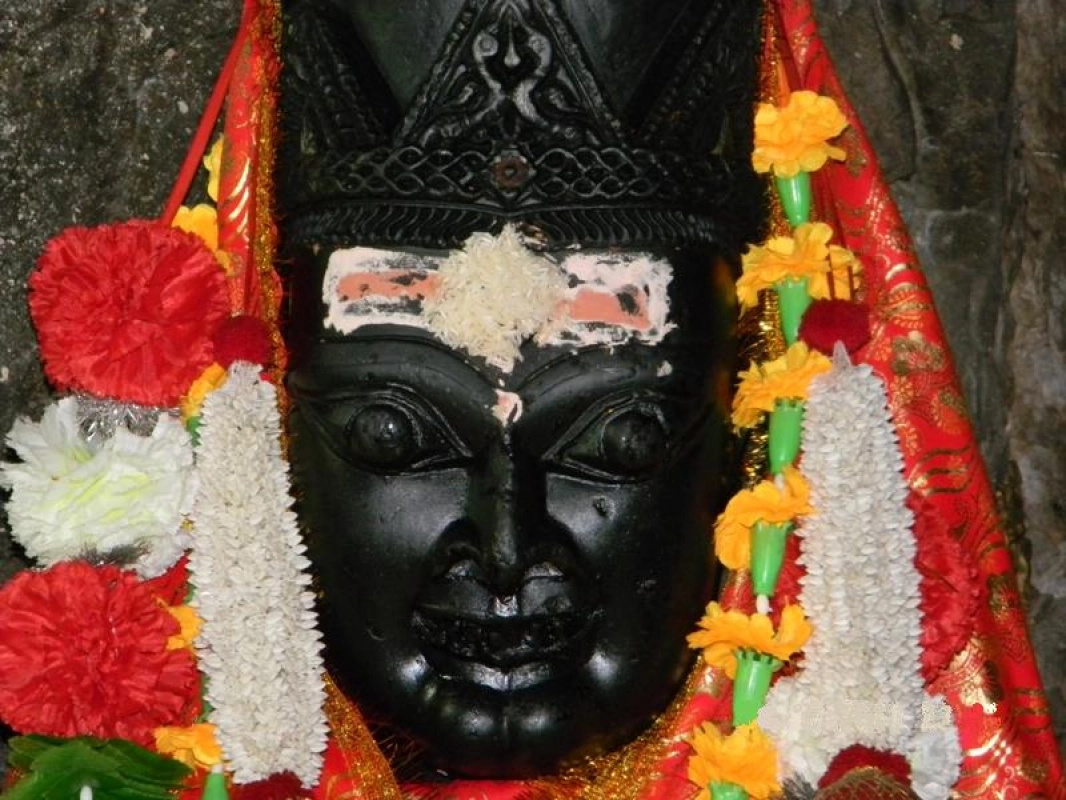
On the swift, turquoise waters of the Alaknanda River near Kalyasaur village in Pauri Garhwal, Uttarakhand, rises a rock that has cradled one of the most powerful and revered Shakti shrines in the Himalayas — the Dhari Devi Temple. Enshrined here is the upper half of Goddess Dhari Devi, a fierce manifestation of Kali and the guardian of all four Char Dham pilgrimage sites of Uttarakhand. Open to the sky as commanded by divine decree, this temple on the Alaknanda has witnessed floods, royal attempts at relocation, modern dam controversies, and the thunderous events of 2013 — all of which have deepened, rather than diminished, the devotion that draws millions of pilgrims to her feet.
The Goddess — Dhari Devi
Dhari Devi is worshipped as a fierce (ugra roop) manifestation of Goddess Kali — specifically venerated in Garhwali tradition as Dakshin Kali or Kalyaneshwari. She embodies the protective, cosmic feminine power (Shakti) that sustains and guards the sacred Himalayan land of Uttarakhand. She is universally regarded as the Raksha Devi (protective goddess) of Uttarakhand and is said to hold under her divine care all four Char Dham pilgrimage destinations — Kedarnath, Badrinath, Gangotri, and Yamunotri — as well as the rivers and mountain passes that connect them. Devotees believe that no Char Dham yatra is complete or safe without first seeking the goddess's blessing at Dhari Devi.
The idol at Dhari Devi Temple represents only the upper half of the goddess (head, face, and torso). Her lower half is enshrined approximately 63 km away at Kalimath Temple in Rudraprayag district, on the banks of the Saraswati River, where the goddess is worshipped in her full Kali form. Together, the two shrines are recognised as one of the 108 Shakti Sthals described in the Srimad Devi Bhagavata Purana — a single divine presence split between two sacred locations, with Dhari Devi and Kalimath being complementary halves of the same cosmic goddess.
The Living Idol — The Three-Form Transformation
Among the most celebrated and mysterious aspects of Dhari Devi is the devotional tradition that the goddess's expression changes visibly through the course of each day. As reported by countless priests, longtime devotees, and pilgrims over generations:
- Morning (dawn to noon): The face of the goddess appears as that of a young girl (bal roop / balika)
- Afternoon (noon to dusk): The face transforms to that of a young woman (yuvati)
- Evening (dusk): The face appears as that of an elderly woman (vriddha)
This triple manifestation is spiritually interpreted as the goddess embodying the three stages of human life, the three gunas of creation, and the three aspects of the Tridevi. The change is experienced through the shifting play of natural light upon the dark stone and the deep spiritual receptivity of the observer. It is treated as a divya leela (divine play) — an extraordinary spiritual tradition attested by generations of devotees at this temple.
The Origin Legend
The temple's founding is intertwined with a legend of divine instruction. The original shrine was located upstream at Dhari village — from which the goddess takes her name. A devastating flood swept the idol downstream, where it came to rest against a rock at Kalyasaur on the Alaknanda. When villagers gathered around the recovered idol, they heard a divine voice (akashvani) instruct them: "Do not move me further. Install me here, in the open, without a roof." The villagers obeyed, and the shrine was established at that very rock in the river. The commandment of no-roof has been honoured ever since — the idol remains open to the sky to this day, exposed to rain, sun, and the sounds of the river below.
An additional Garhwali folk tradition speaks of the goddess being the only sister among seven brothers. After a series of misfortunes, she was separated from her family, and her presence came to rest at the rock on the Alaknanda. This legend is used to explain why only the upper half of the goddess is present here — the complete form being divided between this site and Kalimath.
According to local oral tradition and temple lore, Adi Shankaracharya visited and consecrated this site during his 8th-century travels through Garhwal when he established the Char Dham circuit — recognising the goddess's presence on the Alaknanda rock as the divine guardian of the pilgrimage routes he was formalising.
The 2013 Controversy and the Kedarnath Disaster
No account of Dhari Devi Temple is complete without the events of June 16, 2013 — one of the most discussed intersections of devotion and disaster in modern India.
The Srinagar Hydroelectric Project (330 MW) on the Alaknanda, developed by Alaknanda Hydro Power Company Limited (AHPCL), a subsidiary of GVK Power & Infrastructure Ltd, required raising the water reservoir to a level that would submerge the original mid-river rock where Dhari Devi's temple stood. After years of legal battles — petitions filed in the Uttarakhand High Court and the Supreme Court of India by activists and devotees — the Supreme Court ultimately allowed the relocation, ruling that raising the temple platform did not infringe upon devotees' rights.
On the evening of June 16, 2013, workers used a crane to physically lift the Dhari Devi idol from her centuries-old perch on the Alaknanda rock and transfer her to a raised concrete platform at the same location. Priests and devotees who had gathered to protest watched in distress as the goddess was moved.
That same night, within hours, a catastrophic cloudburst struck above Kedarnath in the Mandakini valley. The moraine dam of the Chorabari glacial lake failed, sending a massive wall of water and debris crashing through Kedarnath town. Thousands of pilgrims and residents perished — it was the worst natural disaster in Uttarakhand's recorded history. For millions of devotees, the timing was not coincidental: the guardian goddess of the Char Dham had been displaced from her sacred station, and the Char Dham she had always protected bore the consequences.
This conviction was reinforced by a historical parallel: in 1882, a local ruler had attempted to relocate the Dhari Devi idol, after which a severe landslide struck the region, affecting Kedarnath. That precedent had been cited in warnings issued before the 2013 relocation — warnings that went unheeded.
The idol was subsequently reinstated at the elevated platform above the Alaknanda at the same Kalyasaur location, where she continues to be worshipped today.
The Temple
The present temple stands on a raised concrete platform built on pillars above the Alaknanda River, at the same sacred location as the original rock. Access is via a pedestrian bridge from the NH-58 (Rishikesh–Badrinath highway) embankment on the left bank. The sanctum remains open to the sky — no roof — honouring the ancient divine commandment. The structure incorporates elements of North Indian Nagara-style shikhara architecture combined with Pahadi (Himalayan hill architecture) woodwork and stone ornamentation. The surrounding hills, the rushing Alaknanda, and the open-air sanctum together create an atmosphere of raw, elemental spiritual power.
Festivals
- Chaitra Navratri (March–April): The most important festival, attracting pilgrims from across Garhwal for nine nights of yagnas, aartis, and intense devotional gatherings
- Sharad/Ashwin Navratri (September–October): The second major Navratri, coinciding with Dussehra season; equally significant
- Char Dham Season: The temple sees surges in pilgrims at the opening (April–May) and closing (October–November) of the Char Dham yatra, as devotees stop for the goddess's blessing
- Diwali, Kartik Purnima: Observed at the temple with special rituals
Visitor Information
- Location: Kalyasaur, Dang Chaura, on NH-58 (Rishikesh–Badrinath highway), between Srinagar (Pauri Garhwal) and Rudraprayag, Uttarakhand
- Distance: ~14–16 km from Srinagar (Pauri Garhwal) | ~19–20 km from Rudraprayag | ~115 km from Rishikesh | ~142 km from Haridwar
- Timings: 6:00 AM – 12:00 PM | 2:00 PM – 7:00 PM (daily); Morning aarti at 6 AM, Evening aarti at 6:30 PM
- Entry fee: Free
- Photography: Strictly prohibited inside the sanctum
- Nearest airport: Jolly Grant Airport, Dehradun (~120–136 km, approx. 4 hours)
- Nearest railhead: Rishikesh Railway Station (~115 km)
- By road: Regular buses and shared jeeps from Rishikesh/Haridwar to Srinagar (Garhwal) pass the temple directly on NH-58. From Rudraprayag, auto-rickshaws and taxis are available (~19 km)
- Best time to visit: Navratri seasons (March–April and September–October); also April–June (Char Dham season, pleasant weather). Avoid heavy monsoon months (July–August) due to landslide risk on Himalayan roads.