Somnath Temple
Somnath Jyotirlinga Temple
Prabhas Patan, near Veraval, Gujarat, India

 Nearby Airport: Diu Airport - 60 km
 Nearby Railway Station: Veraval Railway Station
 Nearby Bus Station:
Somnath Bus Stand
Nearby Bus Station:
Somnath Bus Stand
Description:
Introduction
Somnath Temple at Prabhas Patan near Veraval in Gujarat is revered as the first among the twelve sacred Jyotirlingas of Lord Shiva. Standing on the Arabian Sea coast, the temple is worshipped as Shree Somnath Mahadev, the Lord of Soma, and is one of the most important tirtha kshetras in India.
Somnath is more than a single shrine. It is a sacred landscape where sea, river confluence, mythology, history, national memory, and living worship meet. The present temple, consecrated in 1951, continues a tradition that has endured cycles of destruction, rebuilding, and renewed devotion.
Sacred Meaning
The name Somnath means “Lord of the Moon.” According to tradition, Chandra, the moon god, worshipped Lord Shiva here to be freed from a curse and regained his radiance by the grace of Mahadev. Because of this, Somnath is associated with healing, renewal, and the return of inner light.
As a Jyotirlinga, Somnath represents Shiva as an infinite pillar of divine light. Devotees visit the shrine to seek blessings for strength, forgiveness, prosperity, spiritual clarity, and liberation.
History and Resilience
Somnath's history is famous for its repeated destruction and reconstruction. The shrine was celebrated in medieval accounts and drew pilgrims, rulers, merchants, and seekers for centuries. It was attacked multiple times in different periods, yet each time the memory of Somnath survived through devotion and rebuilding.
After India's independence, Sardar Vallabhbhai Patel initiated the rebuilding of the temple on the original sacred site as a symbol of cultural self-respect and national renewal. The Pran Pratishtha of the present temple was performed on 11 May 1951 by Dr. Rajendra Prasad, the first President of India.
Architecture
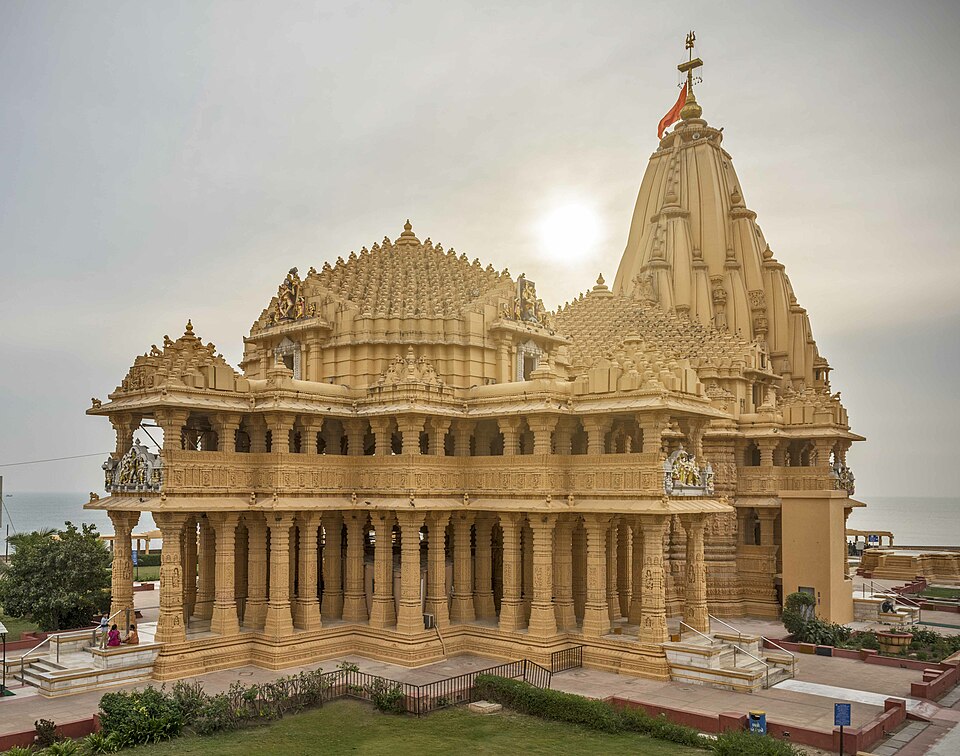
The present Somnath Temple is built in the traditional Chalukya or Maru-Gurjara style, following classical western Indian temple design. Its honey-coloured stone, carved pillars, mandapas, shikhara, and sea-facing setting give the shrine a powerful visual presence.
- Sanctum: The Jyotirlinga of Shree Somnath Mahadev is the sacred centre of worship.
- Shikhara: The rising temple tower symbolises the ascent from earth toward the divine.
- Sea-Facing Axis: The temple stands at the western edge of India, facing the Arabian Sea.
- Baan Stambh: The arrow pillar near the sea indicates the uninterrupted southward expanse of ocean from Somnath toward Antarctica.
- Temple Complex: The larger precinct includes devotional spaces, pilgrim facilities, nearby tirthas, and cultural interpretation.
Prabhas Tirtha and Nearby Sacred Places
Somnath is part of the larger Prabhas Tirtha, a sacred area associated with many Hindu traditions. The region is linked with the confluence of sacred river streams and with the final earthly journey of Lord Krishna.
- Triveni Sangam: A revered confluence associated with Kapila, Hiran, and Sarasvati streams.
- Bhalka Tirth: The place traditionally linked with the episode where Lord Krishna was struck by the hunter's arrow.
- Dehotsarg Tirth: Associated with Lord Krishna's departure from the earthly realm.
- Prabhas Museum: A place where visitors can see archaeological remains and sculptures connected with the older temple heritage.
Festivals and Worship
Daily worship at Somnath includes darshan, aartis, abhishekam, and devotional offerings to Lord Shiva. Maha Shivaratri is the grandest festival, celebrated with deep devotion and heavy pilgrim footfall. Kartik Purnima, Shravan month, Mondays, and Pradosham are also important for Shiva devotees.
- Maha Shivaratri: Night-long Shiva worship, fasting, chanting, and special pujas.
- Kartik Purnima: A sacred full-moon occasion celebrated with devotion at the tirtha.
- Shravan Month: A highly auspicious period for Shiva abhishekam and pilgrimage.
- Sound and Light Show: The temple precinct is known for an evening presentation narrating Somnath's history and sacred memory.
How to Reach
Somnath Temple is located at Prabhas Patan, near Veraval, Gir Somnath district, Gujarat.
- By Train: Somnath and Veraval railway stations connect the pilgrimage town with major Gujarat and Indian routes.
- By Road: Somnath is connected by road with Junagadh, Porbandar, Dwarka, Rajkot, Ahmedabad, and other Gujarat cities.
- By Air: Diu, Rajkot, Porbandar, and Ahmedabad airports are commonly used depending on travel route and flight availability.
Visitor Information
- Best Time to Visit: October to February offers pleasant weather; Maha Shivaratri and Kartik Purnima are spiritually powerful but crowded.
- Dress Code: Modest, respectful clothing is recommended for darshan.
- Booking: Use the official Somnath Trust channels for rooms, pooja, donation, prasad, and live darshan services.
- Security: Follow temple security instructions and avoid carrying restricted items.
- Nearby Itinerary: Bhalka Tirth, Triveni Sangam, Dehotsarg Tirth, Prabhas Museum, Gir National Park, and Dwarka can be combined with Somnath pilgrimage.
Other temples in this group